
Sealed Windows in Winter: “Hypoxia” and “Stuffiness” Are Two Different Problems — A Guide to Room Setup and Ventilation for Plateau Oxygen Users
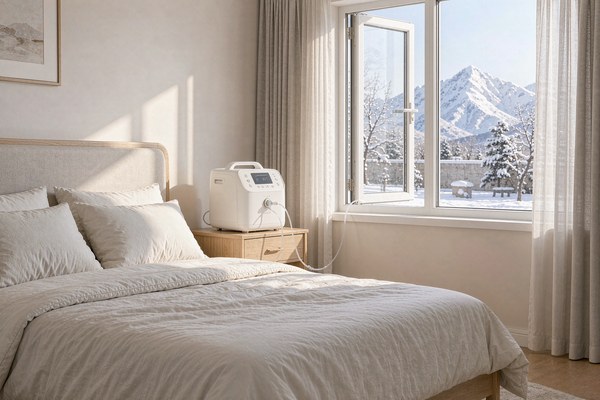
When the winter heating season arrives, the windows at home start "hibernating" too: no one wants to open them in daylight for fear of losing the sun's warmth, and at night the fear is of cold air seeping in, so doors and windows get shut as tightly as possible. For households that use oxygen, this hides a common misunderstanding — the tighter the room, the more oxygen there is. The truth is that hypoxia and stuffiness are two entirely different problems. A concentrator raises the oxygen concentration, but it does not create fresh air; in a tightly sealed room, carbon dioxide is quietly climbing too. This article sorts out, once and for all, how to set up the room and how to ventilate it.
1. Understand this first: a concentrator does not "make" fresh air
Most home oxygen concentrators use molecular-sieve oxygen production, on the principle of pressure-swing adsorption (PSA): a compressor pushes room air into a molecular sieve, nitrogen is adsorbed while oxygen passes through, and the separated nitrogen is released back into the room. The whole process merely rearranges the components of the air; it does not draw a single breath of fresh air in from outside.
This means two things. First, it does not consume the oxygen in the room, so in a sealed space oxygen only accumulates — it never "runs out from use". Second, it does nothing about the carbon dioxide people exhale: the tighter the room, the more people in it, and the longer they stay, the more CO2 builds up. So hypoxia is handled by the concentrator, while stuffiness is handled by ventilation — neither substitutes for the other. Some winter cases of "head getting fuzzier the more I use oxygen" are not the machine's fault; the room simply needs airing.
2. Which room to put it in: three principles
1) The bedroom first. Night is the longest stretch of oxygen use, and nasal-cannula users keep using it in their sleep. Putting the unit in the bedroom or the room next door is far more practical than putting it in the living room. Keep a little distance from the head of the bed — don't blow straight at the face — run the tubing along the baseboards, and leave a clear path so no one trips during a night-time trip to the bathroom.
2) Match floor area to flow. A small-flow machine cannot serve a large space. A nasal cannula is "point-to-point": oxygen goes straight up the nose, so room size matters little. But diffuse oxygen supply works by raising the concentration of the whole room, and the main unit's flow must match the room's volume. Forcing a small machine to fill a large living room gives poor results, and the machine cannot take the strain.
3) Avoid four kinds of spots. Keep away from fire sources, radiators, and oily smoke (the fire-safety requirements of high-concentration-oxygen environments were covered in our heating-season fire checklist). Avoid positions with long hours of direct sunlight, which ages the housing and the control panel. Don't pile objects within about 20 cm of the air intake, and don't press the unit flat against a wall. Bathrooms and kitchens — damp and heavy with fumes — are not suitable.
3. The balance between sealing and ventilating
Complete sealing is neither necessary nor comfortable. Following general public-health advice, air the room two to three times a day, 20 to 30 minutes each time; in winter, do it briefly around midday when the temperature is highest. Opening two windows opposite each other for cross-ventilation is far more efficient than a single window. During those ten or twenty minutes of airing, nasal-cannula users can pause oxygen briefly with no ill effect. Households with diffuse supply don't need to switch off: the oxygen concentration dips briefly while airing and recovers afterwards — no need to worry.
If airing every day feels like a hassle, there are two compromises. First, fit weather-stripping to doors and windows to solve the heat-loss problem, but don't chase "absolute airtightness" — the natural cracks of an older house are not a bad thing; they quietly exchange air. Second, for homes with a fresh-air system, stagger the ventilation periods away from the peak hours of diffuse oxygen supply, or lower the fresh-air setting — fresh air brings in outdoor air and dilutes the indoor oxygen concentration, which diffuse-oxygen households should keep in mind.
In short: keep the warmth and get the fresh air — achieving the two goals in turn comes closer to comfort than choosing one over the other.
4. Electrical load and equipment pairing
Winter is peak season for electricity. Before running the electric heater, electric blanket, humidifier, and concentrator all at once, check whether they share the same circuit. A typical home concentrator draws from a few hundred watts up to about a kilowatt; sharing a power strip with an old-style electric heater means a tripped breaker is the small problem, while heat building up in the wiring is the big one. If circuits need splitting, call an electrician.
Don't double up on humidification: a humidifier bottle fitted to the oxygen tubing is enough. Adding an ultrasonic humidifier on top pushes humidity too high, which breeds bacteria and dampens the walls. Also, air purifiers do not consume oxygen and can share a room with a concentrator — just make sure the purifier doesn't block the machine's air intake.
5. Three details for diffuse-oxygen rooms
Mount the oxygen outlets above the areas where people move about, not blowing straight at the head of the bed, and don't cover the outlets with clothes or clutter. If you only use the bedroom at night, close the doors to the other rooms — diffuse oxygen concentration is maintained by "closing the doors", and with every door open, even a large main unit can't keep up. In homes with heavy kitchen fumes, keep the outlets well away from the direction of the stove.
6. Q&A
Q: Is a smaller room better, since the oxygen concentration gets higher?
A: No. In a small room, concentration rises faster — but so does CO2. Oxygen therapy is judged by blood-oxygen readings and how you feel; enough is enough, and higher is not better. Excessive concentration can actually be harmful to some chronic respiratory patients, and flow should always follow the doctor's prescription.
Q: Will a fresh-air system "blow the oxygen away"?
A: Fresh air brings in outdoor air and dilutes the indoor oxygen concentration, but air exchange itself is necessary. Diffuse-oxygen households can stagger the fresh-air periods away from peak oxygen hours, lower the setting, or use intermittent mode. Nasal-cannula users are barely affected and need not worry.
Q: Can one concentrator serve two rooms?
A: A nasal cannula goes where the person goes — use it in whichever room you're in. Diffuse supply works according to its designed service area, and cross-room coverage is achieved by "keeping doors closed and zoning the rooms". If you want stable concentrations in several rooms at once, the main unit and outlets must be configured according to a plan — don't force one small machine to do it all.
Q: Should we leave a window crack open at night in winter?
A: It depends on how many people are in the room and how airtight it is. Older houses generally have cracks, so nothing deliberate is needed. But in newly built or very well-sealed homes, or when several people share the room, leaving a small gap or running an exhaust fan on low can help — with CO2 down, sleep quality is often better. Rooms with infants are the ones most worth a little air exchange.
Room setup is the foundation of oxygen-therapy results. In heating season, once "where the machine goes and how ventilation works" are sorted out, oxygen and fresh air no longer have to be an either-or choice. Xizang Kuyang maintains a local warehouse and service network in Lhasa with 48-hour response, offering on-site installation, filter replacement, and annual inspection. For any questions about home oxygen-supply planning, call 15608996945.
References: YY 9706.269-2021, Safety and Performance Requirements for Medical Oxygen Concentrators; GB 50751-2012, Technical Code for Medical Gas Systems; Science China, popular-science content on home ventilation and oxygen therapy; the principle of pressure-swing adsorption (PSA) oxygen production is public technical knowledge.
Images are illustrative and may differ from actual product appearance. This article is a general science summary and does not constitute medical advice; follow your doctor's instructions for any oxygen therapy plan.