
Will Oxygen Also "Break Down"? What to Do About Mobile Oxygen Supply in the Car and on the Trail: A Guide to Vehicle-Mounted and Portable Oxygen Use
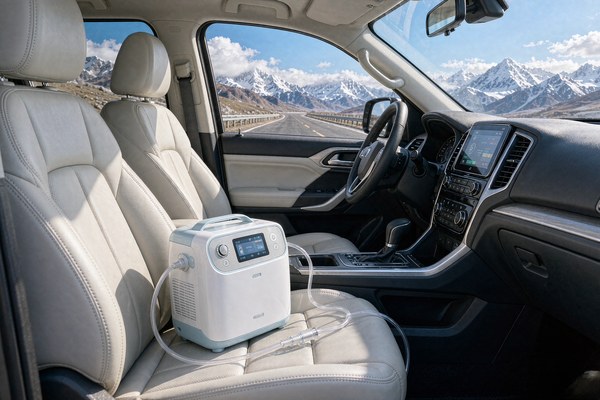
The logic of a home oxygen concentrator is simple: plug it in, switch it on, breathe. But once you are on the road — in the car on a self-driving trip to Tibet, or in a backpack on a mountain trail — oxygen suddenly becomes a field of pitfalls. Where does the power come from? How should the machine be secured? Will the battery survive the cold? Who fixes it if it fails? This article sorts out mobile oxygen use once and for all.
1. Mobile oxygen use and home oxygen use are two different things
At home, three things are silently assumed: stable voltage, a machine sitting level, and accessories you can buy at any time. On the road, all three disappear, replaced by four new problems. The first is power: the car's cigarette-lighter socket, the battery, and a portable power station each have their own temper. The second is motion: bumps, hard braking, and cornering make machine shift and tipping real risks. The third is cold: at low plateau temperatures battery life shrinks noticeably, and rated runtimes — measured under lab conditions — often need to be halved when planning. The fourth is repair: in the middle of nowhere, all you have is the backup you prepared in advance. On top of all this, the higher the altitude, the lower the atmospheric pressure, and the same machine's output concentration will fall somewhat; choosing a unit based on lowland experience may leave you short at altitude, so leave margin in both power and concentration.
2. Vehicle oxygen supply: power, securing, ventilation
Start with power. A concentrator's start-up power is higher than its rated power, so an inverter should be sized with at least double the margin. A cigarette-lighter socket typically supplies only 10-15 amperes, and drawing heavy current for long periods can overheat and burn out the socket; for regular in-car use, have an electrician wire the unit directly to the battery. Do not run oxygen off the car battery with the engine off — deep discharge is far more trouble than fuel; if conditions allow, use a portable power station instead. Next, securing. The machine must sit level, held by its original shock-absorbing pads or straps; in a hard stop, what flies forward is not just the machine. Leave clearance around the unit for heat dissipation, and do not bury it at the bottom of a suitcase. Finally, ventilation and fire safety. The cabin is an enclosed space where high-concentration oxygen can accumulate, so smoking and open flame in the car are strictly prohibited — the same logic as the heating-season fire-safety checklist published earlier. A cylinder riding along must be firmly secured, kept out of direct sun, opened slowly, closed before any movement, and its valve and fittings must be kept free of oil.
3. Portable use outdoors: three numbers before anything else
When buying a portable unit, look at three numbers first. Weight: it is only useful if you can carry it. Battery runtime: rated figures come mostly from lab conditions, so at cold high altitude plan on about seventy percent of the rating. Output concentration: check the specification sheet for whether concentration degrades at higher flow settings, and choose a model that holds concentration steadily at your usual setting. Then think about backup. On long treks and kora circuits, a backup oxygen source (a cylinder or an oxygen bag) is more reliable than a fancier machine, and group travel needs a division of labour agreed in advance: who carries the unit, who can change consumables, who holds the backup. For consumables, carry several spare nasal cannulas, one per person, and check the intake filter daily in windy, dusty conditions. On flow rate: activity makes hypoxia more noticeable, but do not simply turn the flow up. Flow answers "is there enough oxygen", not "am I tired"; turning it up only makes the air drier and drains the machine faster.
4. Three checks before departure, and an emergency plan
Before departure, run three checks. Power: are the device battery, the backup power source, and the car charger all fully charged? Consumables: are nasal cannulas, filters, and humidifier water all packed? Machine: power it on in advance and confirm normal oxygen output. The emergency plan should be settled in advance too. If the machine fails, switch immediately to the backup oxygen source. If a companion develops bluish lips, confusion, or severe breathlessness, stop, descend as quickly as possible, and seek medical care — for altitude illness, descending is the most direct and effective response. For group travel, writing down "who has the equipment and who can operate it" in the itinerary beats improvising on the spot.
5. Frequently asked questions
Q: Can I take a portable concentrator on a plane or train?
A: Transport rules for lithium-battery devices differ by airline and by train service, so confirm with the carrier before travelling. As a general rule, devices with lithium batteries must be carried in the cabin rather than checked, and spare batteries face stricter limits; do not rely on habit.
Q: Is it safe to run oxygen from the car socket all night?
A: Not advisable. Drawing heavy current with the engine off drains the car battery quickly; failing to start the next morning is the small problem, while deep discharge noticeably shortens battery life. For overnight stays, use an external or portable power source.
Q: For trekking, should I carry a portable unit or a cylinder?
A: It depends on duration and weight budget. For short, light trips, a portable unit plus a power bank is enough. For long, heavy trips, make the portable unit the primary source and a cylinder or oxygen bag the backup — do not let oxygen become a single point of failure.
Q: Can I use oxygen inside a tent?
A: Yes, but a tent is an enclosed space, so ventilation is essential, and open flame for heating inside the tent is strictly prohibited. For the consequences of accumulated oxygen meeting fire, refer to the heating-season oxygen fire-safety checklist published earlier.
The core of mobile oxygen use comes down to one sentence: settle power, securing, and backup before you set out, and do not stake anything on "it should be fine". Xizang Kuyang maintains a local warehouse and service network in Lhasa with 48-hour response, offering on-site installation, filter replacement, and annual inspection. For any questions about vehicle-mounted and portable oxygen equipment selection or inverter installation, call 15608996945.
References: YY 9706.269-2021, safety and performance requirements for medical oxygen concentrators; GB 50751-2012, Technical Code for Medical Gas Systems; Science China, home oxygen therapy science content.
Images are illustrative and may differ from actual product appearance. This article is a general science summary and does not constitute medical advice; follow your doctor's instructions for any oxygen therapy plan.