
One Clip on the Finger: How to Read, Buy, and Trust a Pulse Oximeter — A Blood Oxygen Monitoring Guide for Plateau Households
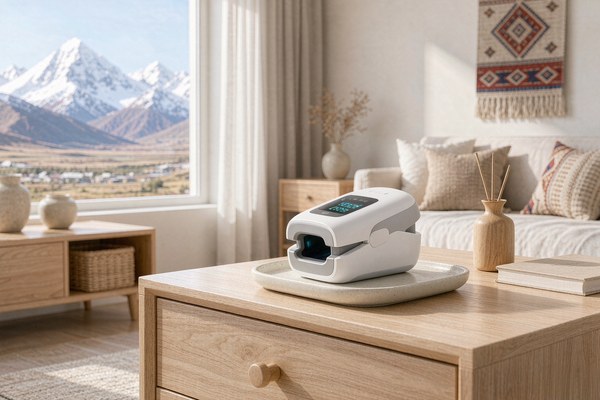
In Lhasa in October, the heating season is starting and mornings and evenings are turning cold. Every year around this time, the same questions start arriving by phone: if the household already has an oxygen concentrator, is a pulse oximeter also worth buying? And how should you read the number that pops up when you clip it to your finger? This article answers both in one go.
1. Why plateau households need a pulse oximeter
Blood oxygen saturation is, simply put, the share of hemoglobin in the blood that is carrying oxygen. A concentrator does the supplying; a pulse oximeter answers whether supply is needed and whether it is enough. It is an assessment tool, not a treatment tool. Late autumn and winter are the high season for respiratory illness, so households with elderly members, COPD or cardiopulmonary patients, pregnant women, or friends and relatives planning to travel to Tibet in winter all need an objective reference value, not a decision made on whether the head feels stuffy. A pulse oximeter is a monitoring device: a single reading only describes the moment, while consecutive records reveal the trend.
2. First find your baseline: what counts as "normal" in Lhasa
For healthy people living at low altitude, resting blood oxygen saturation generally sits between 95% and 100%. As altitude rises and barometric pressure falls, the whole reading shifts downward. Lhasa city sits at about 3,650 metres, where healthy long-term residents commonly show resting readings between 88% and 93%, with obvious individual variation; readings after activity or on waking are lower still. The standard for "normal" here is not the lowland 95%, but your own usual baseline. Record your waking, resting value for three to five days to establish your personal baseline, then read every later fluctuation against it.
3. How to measure accurately: seven easily overlooked details
1. Sit quietly for 5 to 10 minutes first. Measuring immediately after climbing stairs or walking always reads low.
2. Warm your fingers first. Cold hands constrict peripheral blood vessels and produce falsely low readings; wash with warm water or rub your hands together before measuring.
3. Remove nail polish, especially dark shades. It interferes with the optical reading; if you have a fresh manicure, measure on the other hand.
4. Insert the finger fully, clip straight, and hold still. Trembling fingers or talking introduce fluctuations.
5. Avoid blood-pressure measurement. On the arm wearing the cuff, readings taken while the cuff is inflating are unreliable.
6. Measure three times and take the stable value. Do not fixate on a single number; glance at the pulse rate shown, and if it does not match the pulse at your wrist, suspect the measurement before your body.
7. The record matters more than the number. Write down the time, the state (resting, after activity, before or after sleep), and any symptoms together; only then does the trend become visible.
4. When the number drops: judge in three steps
Step one, rule out measurement factors: cold hands, nail polish, a poor clip. Simply measure again.
Step two, look at the trend: if a single low reading returns to your baseline after half an hour of rest, observation is reasonable; if resting values sit clearly below your baseline for days on end, or decline progressively, take it seriously.
Step three, look at the symptoms: persistent shortness of breath, blue lips, chest tightness or pain, confusion, or unusual drowsiness require immediate medical care whatever the number says. Symptoms always outrank numbers.
A special note for COPD and other long-term oxygen therapy patients: the target is not "the higher the better". Guidelines at home and abroad, such as the GOLD report for COPD, generally set a target saturation of 88% to 92%; chasing high readings can suppress the drive to breathe. The specific target should follow your doctor's instructions.
5. Buying tips: look for the medical device registration number, don't worship "smart"
Fingertip pulse oximeters are managed as medical devices, and compliant products must carry a medical device registration number. When buying, check the registration information on the packaging and in the manual; China's National Medical Products Administration has published dedicated purchasing guidance. A large, stable display that also shows pulse rate and perfusion index is more useful; for thin elderly fingers and small children's fingers, a size that fits matters more than a high price tag. Two things should be stated plainly: readings in people with darker skin may be overestimated, and motion artefacts or low perfusion also affect accuracy. Any reading must be interpreted together with symptoms. App connectivity and history curves are nice extras; the core of the matter is always measured accurately.
6. Frequently asked questions
Q: Do healthy people need to measure every day?
A: No. Household members with chronic cardiopulmonary disease, elderly long-term plateau residents, and pregnant women, as well as travellers before and after entering Tibet, can keep periodic or as-needed records. For healthy people without underlying disease, the occasional low reading after exercise rarely matters; only persistently low readings, or readings accompanied by symptoms, need a doctor.
Q: Between the oximeter and the reading built into the concentrator, which do I trust?
A: Trust a standalone, verified oximeter, and cross-check it periodically against hospital equipment or physical examination data. If you have doubts about readings after a year or two of use, contact a professional body for calibration or simply replace the unit.
Q: Is it normal for my saturation to drop into the low 80s after exercise?
A: Exercise itself pulls the reading down, and it usually recovers quickly once you stop and rest. What genuinely warrants vigilance is a persistently low reading at rest, especially when recovery is clearly slower and is accompanied by breathlessness or chest tightness.
Q: Are cheap oximeters sold online usable?
A: Price is not the criterion; registration status is. A device with a medical device registration number and a stable reading is enough; if doubts about readings persist, have them rechecked against professional hospital equipment.
Make "measure, record, compare with your baseline" a habit, and this winter's oxygen decisions have something solid to stand on. Xizang Kuyang maintains a local warehouse and service network in Lhasa with 48-hour response, offering on-site installation, filter replacement, and annual inspection; for any questions about home oxygen plans or equipment selection, please call 15608996945.
References: Science China (Kepu China) popular-science content on home oxygen use and home monitoring; the National Medical Products Administration's guidance on purchasing pulse oximeters (January 2023); the dedicated safety and performance requirements for medical pulse oximeter equipment, aligned with ISO 80601-2-61; the GOLD report for COPD; and this site's articles "How to Prevent Altitude Sickness When Rushing to the Plateau?" and "Before Winter Sets In: A Home Oxygen Checklist for the Plateau".
Images are illustrative and may differ from actual product appearance. This article is a general science summary and does not constitute medical advice; follow your doctor's instructions for any oxygen therapy plan.